
A backpacker picking fruit for a season pays more tax in a week than Australia collects from the AI boom in a year.
Every dollar, every visa, every hour
Australia taxes foreign workers hard. A backpacker on a farm gets pay as you go tax withheld from every shift. Super gets paid into an account she'll probably never touch. None of that depends on how long she's staying or whether she likes it here. If you work on Australian soil, the tax office wants its share.
Now picture a different kind of worker. It runs around the clock in a shed the size of a small suburb, drawing enough power to light a country town, doing the actual thinking that businesses pay for. It works here. It draws Australian electricity, sits on Australian land, and uses water from an Australian grid under real pressure. But almost none of what it earns gets taxed here, because the company that owns it just says, on paper, that the money belongs somewhere else.
Australia's five biggest tech companies made an estimated $15 billion here last year and paid about $254 million in tax between them, a gap The Conversation has been tracking for years. AI makes that gap stranger still. This isn't a website with no local footprint. It's 1.4 gigawatts of computing power Anthropic wants built in Australia by the end of 2027, real buildings, real power use, a real Australian office. Reports on the company's own tender documents confirm it. The work is clearly happening here. The tax bill isn't.
We've solved a problem like this before, just with a different resource. Victoria once charged every gold digger a fee for the right to take gold out of the ground, win or lose, and later taxed the gold itself on the way out of the colony. What we're describing here isn't a new idea. It's an old one, aimed at a new resource.
Signals happening now
These aren't predictions. You can already see them.
- Anthropic has sent a confidential tender to five Australian data centre operators for more than 1.4GW of capacity, big enough to roughly double the country's current fleet
- Bernie Sanders has introduced a bill to fund a US sovereign wealth fund from a one time tax on AI company stock, modelled on Norway and Alaska
- Australia has already forced Meta, Google and TikTok into a mandatory levy over news content, proof Australia can make a move like this and survive US pushback
- New Zealand tried its own digital services tax and dropped it within weeks once Washington threatened tariffs, proof the same pressure can also kill it
- The Assistant Treasurer has publicly ruled out a universal basic income as a response to AI job losses, in the same weeks Atlassian cut 500 Australian jobs citing AI
- The Future Fund already holds a stake in a data centre operator competing for Anthropic's business, a bit of public benefit nobody planned for
What almost nobody capitalised on
Picture the countries that could still power a project this size. Cross out the ones where the grid had already maxed out. Cross out the ones without the land to spare. What was left was a short list, and Australia sat near the top of it.
Training AI ate electricity by the gigawatt, and most of the world didn't have that to spare. Grid capacity, not land or approvals, was what held AI companies back. Australia had what was scarce everywhere else, sun, wind, room to build. Anthropic was one of the first to say so out loud, pointing to the country's renewable potential as part of the reason it came here.
A call centre could move countries in a year. A data centre this size got poured in concrete.
It also changed what the tax could fund. AI companies needed new energy generation built fast, and they were willing to pay for it. That turned into a faster renewable build than Australia could have managed alone, funded because someone finally needed the power badly enough to pay for it.
This was never a story about being generous hosts. Australia held something AI companies couldn't get elsewhere. The only question was whether it priced that like it knew.
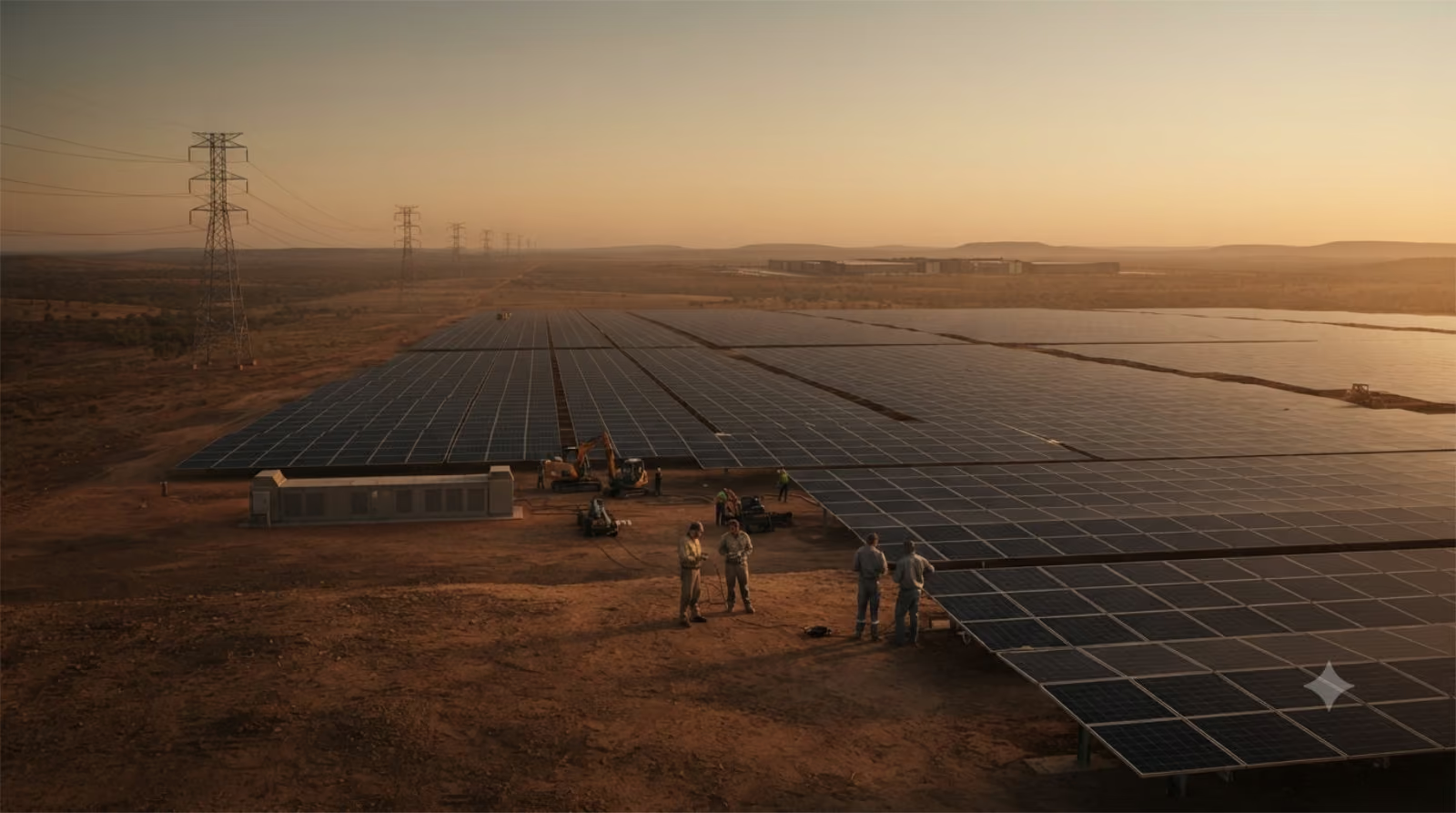
A call centre could move countries in a year. A data centre this size got poured in concrete.
A share nobody had to apply for
By the early 2030s, the job losses weren't isolated cases. Home loan assessors, insurance processors, paralegals, first line customer service, entire categories of white collar work that used to define the middle of the Australian economy stopped hiring within the same few years, all to the same kind of AI system. It wasn't one industry's disruption. It was most of them, on overlapping timelines.
What landed in every Australian's account each quarter wasn't a consolation payment. It was substantial enough that for a huge share of the country, it stopped sitting beside a wage, it did the job a wage used to do. Nobody applied for it. Nobody meant tested it. It was there whether the job was or wasn't, the same way the tax office never used to care whether a wage came from a big company or a small one, only that value was generated on Australian soil.
Here's what actually changed. This was never a tax on land or power draw. It was the same tax that used to come out of a million payslips, just collected from the systems that replaced those payslips instead. Once AI was generating the value that used to flow through Australian wages, the country stopped pretending it could keep taxing income that no longer existed, and started taxing the thing actually producing it.
The fund behind it didn't just collect and distribute. It held real stakes in the same AI infrastructure it taxed, compounding the way any serious sovereign fund does. The dividend wasn't the fund giving something away. It was every Australian owning a small piece of the thing that took the job, and being paid accordingly.

The profit doesn't disappear when the job does. It just stops touching anyone who isn't already holding the shares.
What a country looked like without it
Picture the same jobs disappearing, on the same timeline. Just without anything there to catch people.
The welfare system did what it could. People had already worried it was stretched too thin, even before AI took a third of the country's office jobs. It was never built to replace income on this scale. It was built to help people get from one job to the next, back when the next job still existed. Hundreds of thousands of people hit it at once, all fighting over a safety net built for a much smaller problem.
The money made by the machines that replaced all those jobs didn't disappear. It just went to whoever owned the AI companies and their shares, growing somewhere else, for someone else. Spending dropped hard in the towns hit hardest, because the money that used to flow through local wages didn't flow through anything now. Shops closed. Regional towns hosting the data centres were left with the power bills and water shortages that came with them, and never saw a cent back.
That was the version Australia chose not to have. Not a missed bonus. A country that hosted the whole transition and ended up owning none of it.
What would have to be true
This scenario is plausible but it isn't inevitable. Three things would need to go right.
Australia has to price its energy and land advantage, not hand it over to attract investment. The country currently competes for AI infrastructure the same way it always has, by keeping costs low and approvals easy. That's backwards. The scarcity of places with Australia's combination of sun, wind, and open land is the actual leverage this whole idea depends on, and treating it as a giveaway instead of a price is the most likely way this fails before it starts.
The tax has to grow automatically as AI takes over more of the economy. It can't be a rate fixed once and forgotten. A deal struck today and left alone would be worthless within a decade, because everyone already expects AI's share of the economy to keep growing fast. The tax needs to move with the economy every year, not sit still while everything around it changes.
The money has to survive the exact moment everyone wants to spend it straight away. Job losses on this scale create huge pressure to hand out cash the second people start losing work, instead of letting the fund grow first. That's the hard part. It's tempting, and it feels fair, to spend the money now. But spending it now is exactly what turns this into a one off payment instead of an income that lasts.
Signal sources
- The Conversation, 'Australia could tax Google, Facebook and other tech giants with a digital services tax, but don't hold your breath'
- w.media, 'Anthropic reportedly seeks up to 1.4GW of Australian data centre capacity'
- Senator Bernie Sanders, 'Sanders introduces legislation to create $7 trillion AI sovereign wealth fund'
- TechCrunch, 'Australia forces Big Tech firms to pay for news or face a 2.25% tax'
- Michael West, 'Past disruptions show Australian workers can weather AI'
- Deloitte, 'APAC sovereign investors move from caution to commitment on AI'
- MinterEllison, 'AI and tax: implications for global businesses in Australia'
- Parliamentary Budget Office, 'Digital services tax costing'
- Ergo, State Library Victoria, 'Land, taxation and revenue'
- Anthropic, 'Australian government and Anthropic sign MOU for AI safety and research'
- CNBC, 'Anthropic's latest hiring spree reveals where it's building AI data centers next'
- pv magazine Australia, 'Data centre demand is new driver for SunCable project'
What this means for your business
Professional services
Charging by the hour stops making sense once AI can do the same work in minutes. Firms that keep billing for time nobody actually spent won't last. What's left to sell is judgement, someone who can put their name on the advice and be held responsible if it's wrong. AI still can't do that part. Firms start charging for the risk they carry, not the hours they worked. That's a completely different business to run.
Healthcare
Hands on care jobs hold up better than admin, diagnostics and scheduling, which don't. That creates two very different experiences inside the same workplace. One group is busier than ever, helped along by AI. The other relies on the dividend as their actual income. Plan for both realities under the same roof.
Retail
AI doesn't just cut costs in retail, it cuts jobs too. At the same time, more shopping money is coming from the dividend, not wages. Businesses that assumed spending would always track employment need a new model. For a lot of shoppers, those two things have quietly stopped matching up.
Consumer products
Once a big share of household income comes from the dividend instead of a payslip, spending power stops following the job market the way it used to. That changes who's buying, when, and how much they've got to spend, no matter what's happening in their own industry. Planning demand around employment numbers alone stops working.
Education
This is the sector the whole story runs through. Retraining stops being an extra and becomes a real, funded part of what schools do, paid for by the same tax that replaced everyone's wages. The bigger change is what happens when the pressure comes off. A lot of what schools focus on now, testing, ranking, subject choices picked for job prospects, comes from families needing school to lead somewhere safe and secure. When a wage isn't the only thing standing between a young person and a good life, school gets room to be what it was always meant to be. Curiosity. Citizenship. Growing into a well rounded person. Not a classroom shaped by the economy's fear about jobs.
The question worth sitting with
Somewhere between the backpacker and the data centre, Australia already decided that work done here gets taxed here. What's still undecided is whether that idea survives contact with a worker made of silicon instead of a person. If we don't answer that question on purpose, someone else will answer it for us, quietly, one tender at a time. Who gets the wealth of this new digital world, and who's just hosting the machine that makes someone else rich?