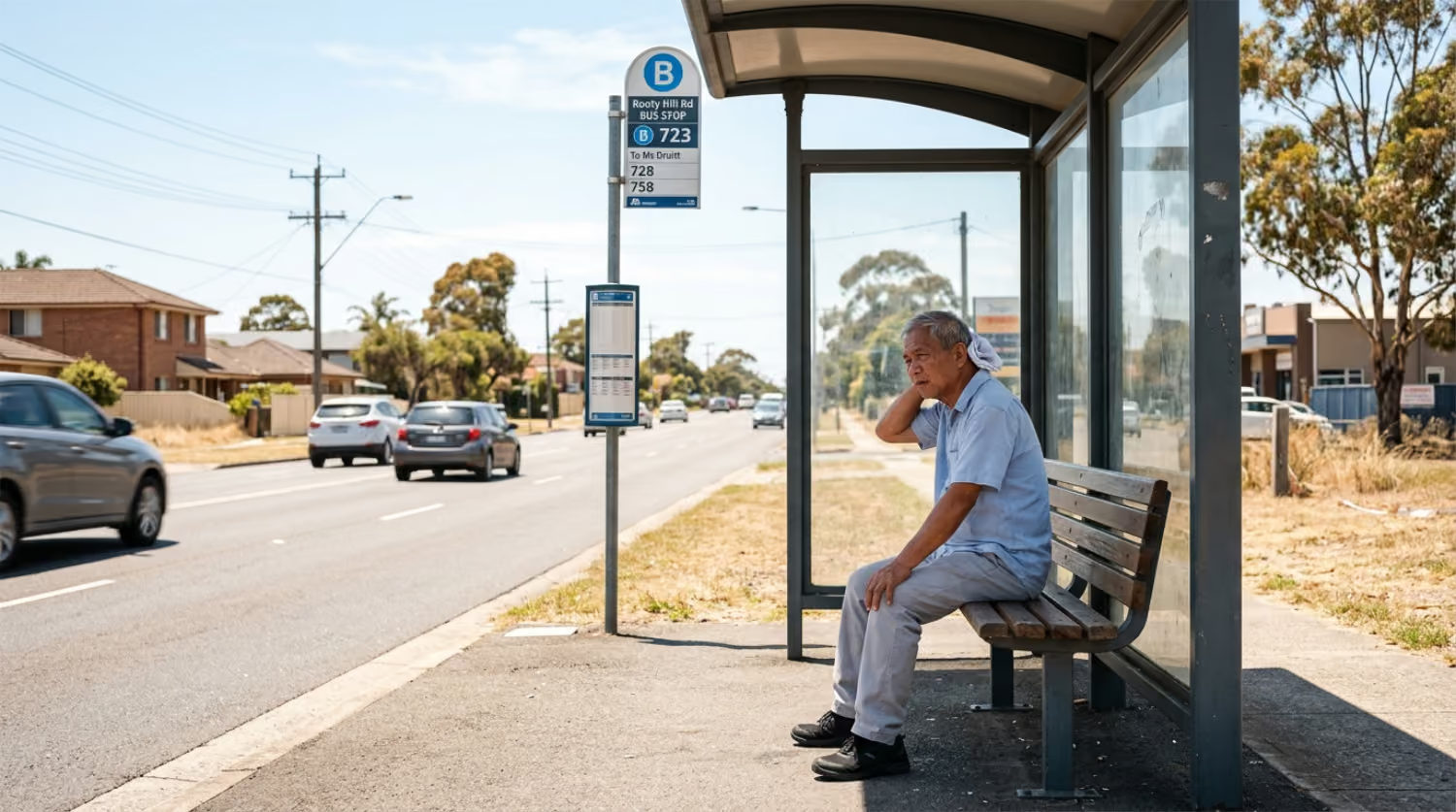
Pressure from every direction
June's scan finds Australia navigating pressure on every front at once. Australians trust their institutions more than they did a year ago, but trust in each other keeps falling. AI governance has arrived faster than most businesses expected, with NSW already legislating and a federal clock ticking. The jobs numbers turned negative for the first time this year. Research has put a number on something most people sensed: Australia spends 50 times more subsidising things that harm biodiversity than it does protecting it. The government's digital ID system opens to the private sector in December, and most businesses don't know it's coming. And in health, nearly half a million Australians are already paying up to $600 a month for weight loss medications that the Pharmaceutical Benefits Scheme still won't cover.
Society
Institutional trust is recovering. Trust in each other isn't.
The 2026 Edelman Trust Barometer shows Australia bucking the global trend among developed economies, with trust in key institutions rising from 49 to 54.1 Trust in employers rose five points to 79. Trust in business was also up five points to 59. That's real, and it matters.
The Australian Institute of Health and Welfare (AIHW) tells a different story. Since 2021, Australians have become more pessimistic about their own future and the country's.2 They feel less connected to the people around them. They feel less proud of being Australian. They feel worse about their finances than at any point on record.
These findings aren't contradictory. They describe two different kinds of trust: trust in institutions and trust in the people around you. The first is recovering. The second is still eroding. While 64% of Australians remain optimistic about the country's future in three years, that's down from 72% in 2021.3 People are responding by focusing on what they can control rather than waiting on others.
You can build institutional trust from the top. Trust between people gets built differently. Organisations that understand that distinction are investing in the spaces where people actually connect, not just in how they communicate.
Type: Emerging | Strength: Strong | Rationale: Edelman Trust Barometer and AIHW are independent, high-authority primary sources producing complementary rather than conflicting findings.
Technology
NSW just made AI a workplace safety issue. The rest of the country is watching.
NSW has passed the Digital Work Systems Act 2026, which creates new work health and safety duties for any business using AI, algorithms, automation, or online platforms to allocate or manage work.4 The law is written broadly. It's not just for gig economy apps. It applies to businesses of all sizes, across every industry.
The law says businesses have to check whether their software is making people's working lives worse: whether it piles on too much pressure, leaves workers no say in how their day runs, makes them feel constantly watched, or makes decisions about them that nobody can explain. Most businesses haven't asked these questions yet.
At the federal level, from 10 December 2026, the Privacy Act will require businesses to tell people how their personal information is used when automated systems make decisions that affect their rights or interests.5
If your business uses software to set targets, schedule shifts, screen job applications, or monitor performance, you now have legal obligations you didn't have six months ago. The question is whether you know it yet.
Type: Emerging | Strength: Strong | Rationale: NSW legislation confirmed by multiple legal and regulatory sources. Federal Privacy Act amendment confirmed by the Department of Industry and Bird and Bird regulatory tracker.
Economy
Jobs fell in April for the first time this year.
The Australian Bureau of Statistics (ABS) released April labour force data on 21 May. The unemployment rate rose from 4.3 to 4.5%, and the economy shed 18,600 jobs over the month.6 It was the first drop in employment this year, and the rate is now above what both Treasury and the Reserve Bank of Australia (RBA) had been forecasting.
The minutes from the RBA's May meeting make clear the rate rise was designed to give the bank room to watch.7 Chief economist Sarah Hunter said headline inflation is expected to peak at 4.8% in the June quarter and then start falling, which suggests the bank is now more interested in what people are spending than in what prices are doing.
The rate cycle isn't finished. But it's probably close to its ceiling.8 Vanguard has cut its 2026 GDP growth forecast to 1.8%, pointing to Australia's heavy reliance on imported oil and the weight of higher interest rates on household spending.9 Its base case is a pause to year-end, as long as the jobs market keeps softening.
People are spending less. Hiring may get easier sooner than most businesses are planning for. But wages are still not keeping up with prices, which means the relief people are waiting for hasn't arrived yet.
Type: Emerging | Strength: Strong | Rationale: ABS primary data corroborated by RBA minutes, Vanguard, and multiple economic forecaster sources. The first job loss of the year is a genuine data point, not noise.
Environment
Australia is spending 50 times more harming nature than protecting it.
Research published in the Australasian Journal of Environmental Management in February 2026 identified $26.3 billion in government subsidies that harm biodiversity in Australia's 2022-23 federal budget.10 Fossil fuel extraction and use, agriculture, fisheries, and forestry got the most damaging support. Australia has signed international agreements committing it to reform these subsidies. It hasn't started.
That $26.3 billion is 50 times what Australia spends protecting biodiversity each year, which sits at roughly $475 million.11 The two biggest offenders are the fuel tax credit scheme at $7.5 billion a year and road transport spending at $7.7 billion a year.
The Productivity Commission is currently developing Labor's economic reform agenda. This research makes the case that what the government pays for is as important as what it regulates. Australia can't meet its nature commitments while this imbalance holds.
Type: Emerging | Strength: Strong | Rationale: Peer-reviewed research using OECD-recommended methodology, corroborated by the Biodiversity Council. Primary data is from the 2022-23 budget, which is the stated limitation.
Politics
The government's digital ID system opens to business in December. Most businesses don't know it's coming.
The Australian Government Digital ID System is being phased in. It opens to the private sector from December 2026. Right now, only government agencies can participate. Using a digital ID is voluntary, and no business will be allowed to make one a requirement to access their services.12
From 30 November 2026, private sector businesses can apply to join the system as either a provider of digital ID services or a business that uses them. Both come with rules about how they handle people's information.13
The voluntary label is real. It won't stay that way. Once digital ID becomes the normal way Australians deal with government online, businesses that accept it will be easier to deal with than those that don't. Financial services, healthcare, and professional services firms should be deciding now whether they're in or out, rather than scrambling in November.
Type: Emerging | Strength: Strong | Rationale: ACCC, Department of Finance, and Allens primary legal sources all confirm the December 2026 expansion timeline.
Health
Nearly half a million Australians are paying up to $600 a month for weight loss medications the PBS won't fund.
Nearly 500,000 Australians, almost 2% of all adults, are now using GLP-1 medications (injectable treatments that reduce appetite by mimicking a natural hormone, with brands including Ozempic and Wegovy) for weight loss or other medical reasons.14 That's a tenfold increase since 2020. Most are paying privately, often $350 to $600 a month.
The Pharmaceutical Benefits Advisory Committee (PBAC) has made its first-ever positive recommendation for an obesity medication, backing semaglutide (the active ingredient in Ozempic) for people with obesity and established heart disease.15 Broader public subsidy through the Pharmaceutical Benefits Scheme (PBS) isn't expected before late 2026.
The people most likely to need these medications medically are often the ones least able to pay privately. Pharmaceutical companies have been pushing to have obesity classified as a disease rather than a risk factor.16 They've built influence with Australian doctors through payments for educational events, travel, and consultancies. The commercial pressure on PBS listing is real. So are the people paying out of pocket while the PBS decides.
When these medications become publicly subsidised, the cost of obesity-related illness will start to fall for employers and insurers. That shift will happen faster than most are expecting.
Type: Emerging | Strength: Strong | Rationale: PBS and PBAC primary sources corroborated by TGA, YourLifeChoices, and multiple clinical publications. PBAC positive recommendation is a confirmed milestone.
What we're monitoring
Victoria has a history of following NSW on work health and safety law. If the Digital Work Systems Act spreads, businesses using automated management tools will face obligations most haven't planned for. Watch for the first enforcement actions and legal disputes as early signs of how far the Act's reach will extend.
UK submarines have started visiting HMAS Stirling as part of the AUKUS (Australia, United Kingdom, United States) rotational program. AUKUS has moved from a commitment on paper to an operational reality. For businesses near defence, maritime, or advanced manufacturing, real money is starting to move in this direction.
Signal sources
- AICD, 'Australia defies global trust trends'
- The Mandarin, 'Trust, fatalism, and the fragility of Australia's social fabric'
- McCrindle, 'Trends of 2026'
- Moore Australia, 'NSW AI workplace safety laws: Digital Work Systems Act 2026'
- Department of Industry Science and Resources, 'Australian Government response: Senate Select Committee on Adopting Artificial Intelligence report'
- Australian Bureau of Statistics, 'Labour Force, Australia, April 2026'
- RBA, 'Statement on Monetary Policy: May 2026 overview'
- Aussie, 'What experts predict for the RBA's June 2026 interest rate decision'
- Vanguard, 'Our economic outlook for Australia'
- Elton et al., 'Biodiversity-harmful subsidies in Australia'
- Biodiversity Council Australia, 'Identifying and assessing subsidies harmful to biodiversity in Australia'
- ACCC, 'Digital ID regulation'
- Allens, 'Legislating the future of identity verification: navigating Australia's Digital ID Act'
- YourLifeChoices, 'Weight-loss drug boom raises new warnings over safety and access'
- PBS, 'PBAC advice on equitable access to GLP-1 obesity treatments'
- Medscape, 'Medical weight-loss promotion under scrutiny in Australia'