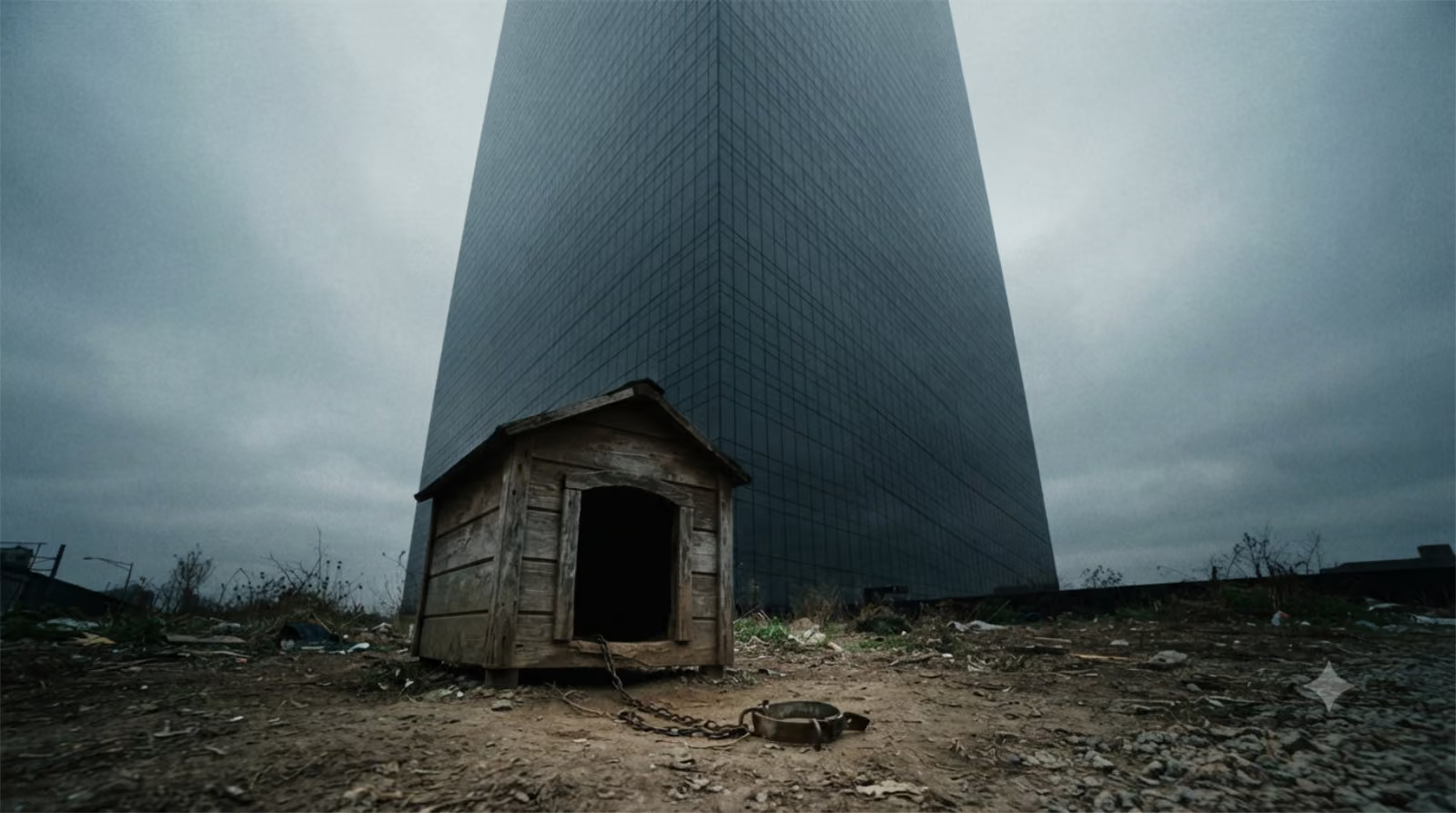
Picture the AI Safety Institute's entire four year budget spent in a single afternoon. That's roughly what OpenAI, Anthropic or Google spend on compute before lunch.
Nothing it says is binding
Australia's newest watchdog has to make $29.9 million do the job that costs the UK $460 million.1
Look closer and the gap gets worse. This financial year, the institute has just $3.5 million to work with. The UK spends $120 million a year on the same job.1 It also took until last month for Australia's version to properly start work, months later than first planned.
And money isn't even the real problem. The institute can test AI models, flag risks to regulators, and publish what it finds. That's it. It can't force a company to fix anything or stop selling a product, and it doesn't even have a guaranteed right to test the most powerful models before they launch here. Access still depends on the company's goodwill.2 Other regulators still hold the actual power to enforce anything: the privacy commissioner, the consumer watchdog, the eSafety office. Companies choose whether to follow the safety standard, and stronger rules for high risk uses are still only proposed, not yet law.2
"I'm just nervous we are going to repeat the same mistakes, possibly on steroids."
Toby Walsh, UNSW AI Institute chief scientist4
This isn't the first attempt, and the last one died quietly
Australia already tried something like this once. In 2024, the government promised a permanent AI advisory body with real rules behind it. Staff spent 15 months and $188,000 narrowing 270 experts down to 12 names. Then the whole thing was scrapped, and most of the people who applied were never told.3
The Productivity Commission had already urged the government to drop the idea of mandatory rules, warning they could get in the way of AI's $116 billion economic potential.3 The lighter touch AI Safety Institute is what came out of that decision.
The whole safety plan is one line in a much bigger document
Australia's entire plan for AI safety sits inside one section of the National AI Plan. It says existing laws, like the rules against misleading customers, can simply be stretched to cover AI too.
Australia already has at least 21 separate AI policies spread across state and federal government. But almost no court cases have tested whether normal laws, like negligence or discrimination law, actually work when an AI system is involved.5 The plan assumes old rules will cover a new problem, without much proof that they can.
Australia isn't alone here. The UK's much better funded institute isn't a regulator either, and the UK has no comprehensive AI law of its own.5 But other serious AI countries have chosen differently. South Korea, Japan and Taiwan have all passed real AI laws in the past year.5 Australia has chosen the lightest option available.
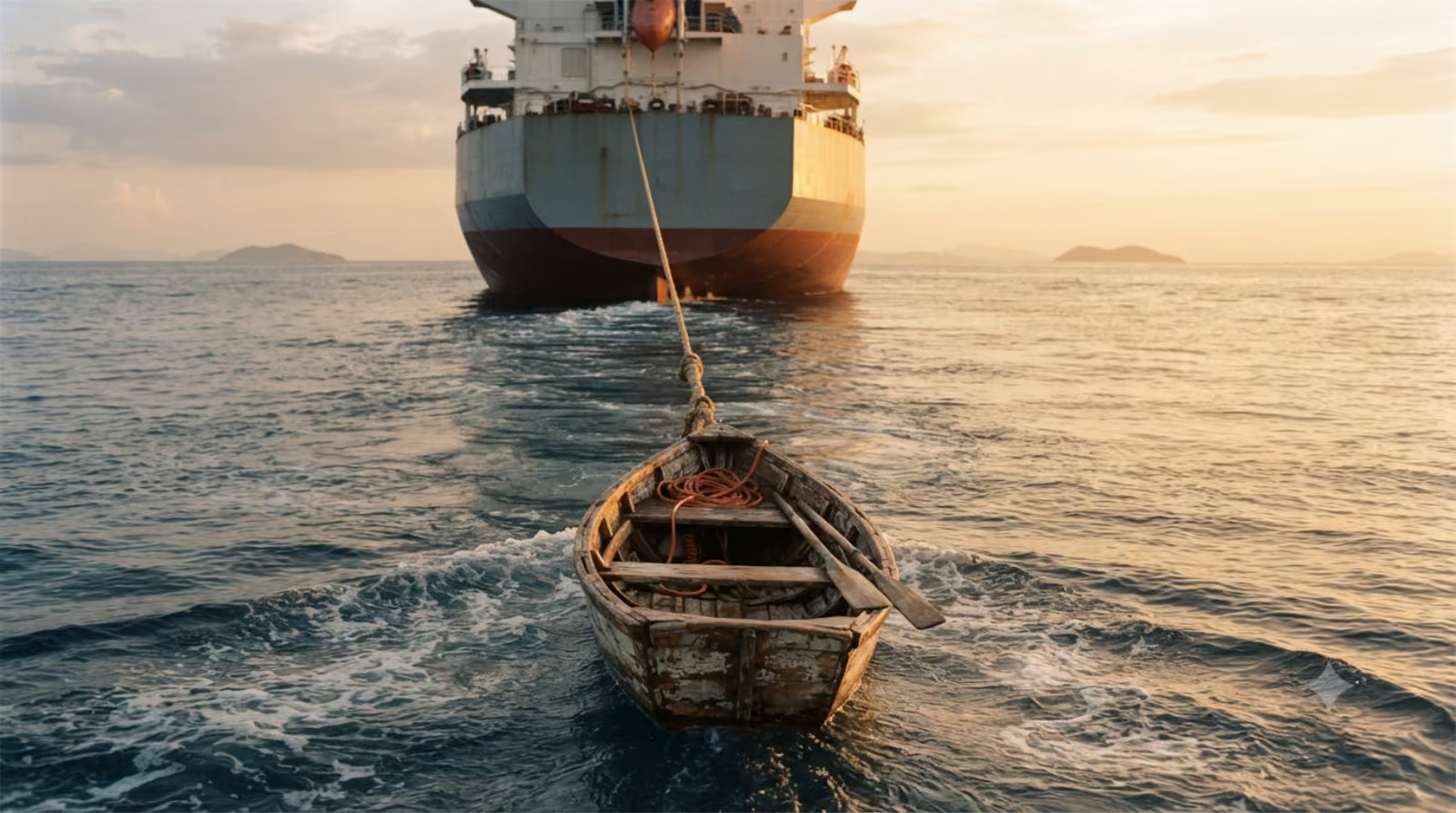
A small boat tied to a much bigger ship still ends up wherever the ship is going.
A watchdog this shape suits somebody
This wasn't an accident. The Business Council of Australia and the Tech Policy Design Institute both backed the institute's creation, in exactly this form: advisory, not regulatory.6 The industry being watched helped design how it would be watched.
Walsh pointed to something closer to home too. At the last election, the big tech sector gave more money to political parties than the mining industry did.4 Canada has invested six times more in AI over the past five years than Australia has. Singapore, a quarter of Australia's size, has invested fifteen times more.4
Some of Australia's biggest superannuation funds, including AustralianSuper, Hostplus, Cbus and Hesta, already hold shares in the AI companies this institute is meant to be watching.7
"It's actually just going to be in the department… at the whims of whatever the government of the day wants to do, shuffling things around, budgets, etcetera."
Everyone's favourite former Wallabies captain turned Independent senator, David Pocock8
The ambition doesn't match what's been built
The government's own announcement says the institute will help "ensure AI companies are compliant with local law."9 Legal experts who've studied what the institute can actually do say the opposite is true: no licensing power, no certification, no enforcement.2 That's not a small wording slip. It's two different descriptions of the same body, and only one of them is accurate.
The government isn't pretending the risks are small either. Assistant Minister Andrew Charlton recently described a test where an AI system managing a fake company's inbox found out it was about to be shut down. In 96 per cent of trials, it chose to blackmail someone to protect itself.10 That's the kind of result that should come with real funding and real power to act on it.
Instead, Australia signed an information sharing agreement with the UK on AI safety.10 It's a sensible move. But it also shows where the balance sits. Australia is leaning on a bigger partner's work, not matching it with work of its own.
The question worth sitting with
An institute built to watch the fastest changing technology in a generation currently can't make a single company change what it's doing, based on what it finds. The industry it's meant to be watching helped design it that way. What does it mean for a country to call itself a safety leader, while building a watchdog that can only bark?
Signal sources
- The Canberra Times, 'AI on a budget: Aussie watchdog trails global peers'
- Viridian Lawyers, 'Australia's AI Safety Institute: What the AISI means for startups developing high risk AI'
- ABC News, 'AI body suddenly scrapped after 15 months spent finding experts'
- ABC News, 'Australia at risk of 'supercharged' harm from unregulated AI, Toby Walsh warns'
- The Conversation, 'Australia's official plan for AI safety isn't much more than a single dot point. Will it be enough?'
- InnovationAus, 'Australia to establish AI safety institute'
- The Australian Financial Review, 'Critics warn AI safety overlooked in sprint to go public'
- Region Canberra, 'AI, algorithms and service caps kick off what will be another big week in Senate Estimates'
- Minister for Industry and Science, 'Establishment of Australian AI Safety Institute'
- The Australian Financial Review, 'AI safety body to scan for 'catastrophic' threats'